
What Is a Prop Firm? How Funded Trading Actually Works

Imagine seeing a trader announce:
“I just received a $100,000 funded account.”
Did they deposit $100,000 of their own money? Usually, no.
With many online prop firms, a trader pays for an evaluation and receives access to an account with a stated size, such as $10,000, $50,000, or $100,000.
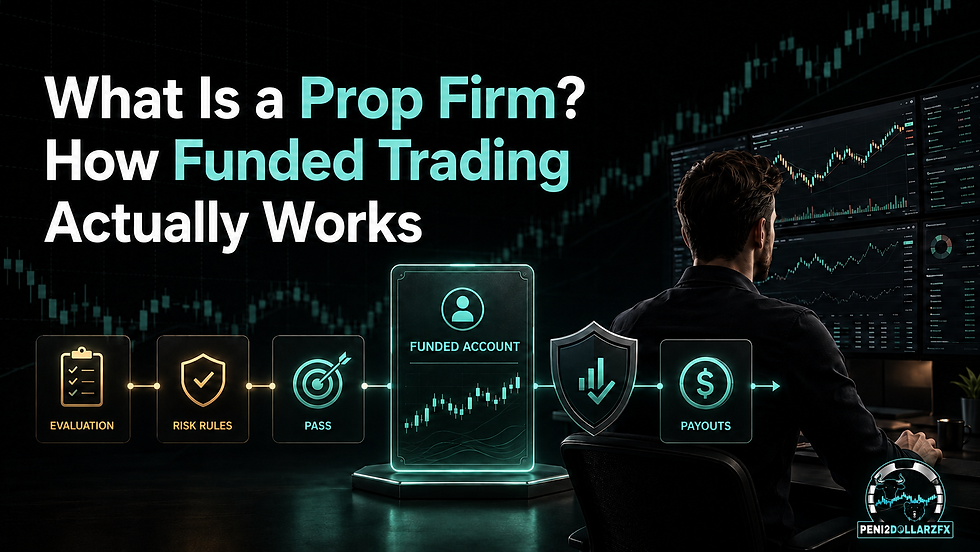
To pass, the trader must reach a profit target without breaking strict risk rules. If successful, they may receive a funded-stage account and earn an agreed share of eligible profits or performance rewards.
The most important point is:
A $100K account does not mean the trader owns $100,000 or can lose $100,000. The real limit is the much smaller drawdown allowance.
At Peni2DollarzFx, we believe traders should understand that risk before paying for any challenge.
Educational notice: This guide is for educational purposes only and is not financial advice. Prop-firm rules, account models, fees, restrictions, and payout conditions vary and may change. Always read the provider’s latest official terms.
What Is a Prop Firm?
A prop firm, short for proprietary trading firm, is a business that trades financial markets using firm capital or a trading arrangement created by the firm.
In simple terms:
The firm provides the trading environment, rules, and capital arrangement.
The trader makes the trading decisions.
Eligible profits are shared according to the agreement.
However, traditional prop firms and modern online evaluation firms are not always the same.
A traditional proprietary trading firm trades its own capital through firm-owned accounts. Traders may be owners, employees, or contractors. This is consistent with the definition discussed in FINRA’s proprietary-trading notice.
Many modern retail-facing prop firms operate differently. They sell evaluations or challenges and may place successful traders into simulated, live, or hybrid funded-stage arrangements.
For example, FTMO currently states that its accounts use demo accounts with fictitious capital, with rewards paid according to the applicable product conditions. Other providers may use different models. See FTMO’s official account explanation.
Therefore, never assume that every “funded account” is live or structured in the same way.

How Does Funded Trading Work?
The typical funded-trading process is:
Choose a program. Review its model, fee, markets, targets, restrictions, risk limits, and payout rules.
Pay the evaluation fee. This normally purchases access to the challenge; it is not a deposit into your personal trading account.
Trade the evaluation. Attempt to reach the required profit target.
Follow every risk rule. Stay within the daily and overall loss limits.
Complete the required phases. Some programs have one phase; others have two or more.
Pass the compliance review. The provider checks your trades and account behaviour.
Receive a funded-stage account or agreement. It may be simulated, live, or hybrid.
Generate eligible profit and request a payout. You must continue following the rules after passing.
In one line:
Choose a program → Pay the fee → Follow the rules → Reach the target → Pass the review → Trade the funded stage → Request a payout
The exact journey varies between providers. FTMO, for example, currently publishes both one-step and two-step evaluation routes. See how FTMO currently works.

The Prop-Firm Rules That Matter Most
Profit target
The profit target is the gain required to pass an evaluation phase.
For example, a hypothetical $100,000 evaluation with a 10% target requires $10,000 in qualifying profit.
However, reaching the target may not be enough. The trader may still need to complete minimum trading days, satisfy consistency requirements, or pass a compliance review.
Maximum daily loss
The maximum daily loss is the most the account can lose during the provider’s defined trading day.
The calculation may include:
Closed losses
Floating losses on open positions
Commissions
Swap or overnight charges
Other trading costs
The daily limit may reset according to the provider’s server time rather than the trader’s local midnight.
A trader in US, for example, should check the exact reset time instead of assuming the limit resets at midnight EST.
Maximum overall drawdown
The maximum overall drawdown is the deepest loss the account is permitted to reach.
It may be:
Static: fixed from the starting balance
Balance-based: calculated using closed account balances
Equity-based: affected by open and closed positions
Trailing: moves upward when the account reaches new highs
The calculation method can be as important as the displayed percentage.
Consistency requirements
Some programs limit how much profit may come from one trading day, one position, or an unusually large position size.
A trader may reach the headline target but still fail a consistency requirement.
Trading restrictions
Rules may cover:
News trading
Overnight or weekend holding
Copy trading
Account sharing
Automated strategies
Maximum lot size or exposure
Hedging between accounts
High-frequency or platform-exploitation methods
Never assume one provider’s rules apply to another. Rules may also change between the evaluation and funded stages.
What a $100K Evaluation Really Means
Consider this simplified hypothetical example:
Item | Hypothetical value |
Starting balance | $100,000 |
Profit target | 10% |
Target profit | $10,000 |
Target balance | $110,000 |
Maximum daily loss | 5% or $5,000 |
Maximum overall drawdown | 10% or $10,000 |
Static breach level | $90,000 |
The displayed account size is $100,000, but the overall risk allowance is only $10,000. The daily room is even smaller.
If the trader loses $5,100 during one defined trading day, the challenge may fail—even though most of the displayed balance remains.
This is one of the most important funded-trading lessons:
The headline size attracts attention. The loss limits control the account.

Drawdown, Balance, and Equity
Drawdown is a decline in account value from a reference point, such as the starting balance or a previous high.
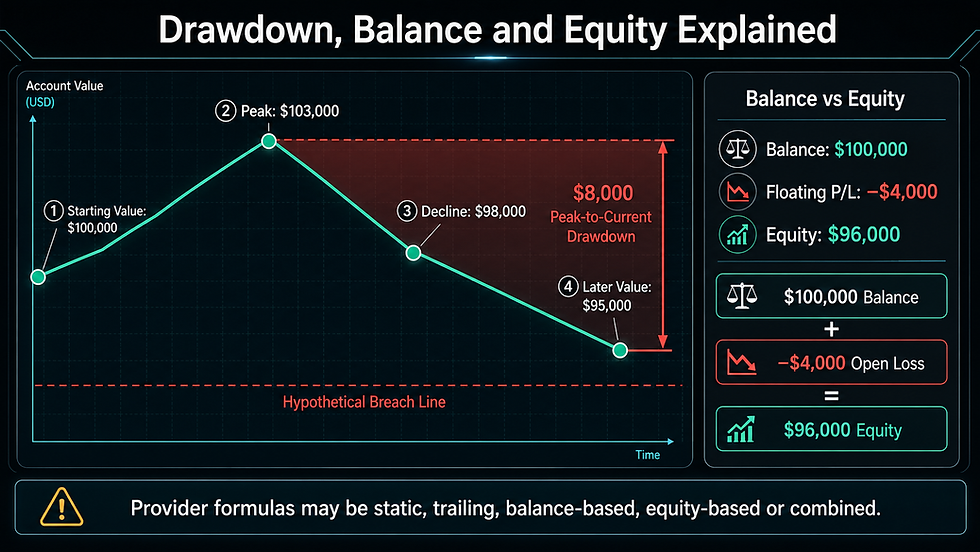
Suppose an account moves like this:
$100,000 → $103,000 → $98,000 → $95,000
The fall from the $103,000 peak to $95,000 is an $8,000 peak-to-current drawdown.
However, a provider’s contractual drawdown formula may use a different reference point.
Two terms are especially important:
Balance: the account value after closed trades are recorded.
Equity: the value after closed trades are recorded.
If the balance is $100,000 and an open trade is losing $4,000, the balance may still display $100,000 while the equity is approximately $96,000 before additional costs.
If the program uses an equity-based rule, that floating loss may count immediately.
Before placing a trade, know:
Whether the limit uses balance, equity, or both
Whether the drawdown is static or trailing
When the daily calculation resets
Whether floating losses and trading costs count
What happens when the threshold is touched
Whether profits move the loss threshold
What Happens After You Pass?
Reaching the profit target is normally followed by a compliance review.
The provider may check:
Trading history
Identity documents
Position sizes
Trading methods
IP or device activity
Rule compliance
Prohibited strategies
If approved, the trader receives a funded-stage account or agreement and continues trading under the provider’s rules.
Passing normally does not remove drawdown limits or guarantee a payout.
The provider may use:
A simulated funded account
A live account
A hybrid model
A system that copies selected activity to its own trading account
The word funded alone does not explain the legal or technical structure. Read the actual agreement.
How Does a Profit Split Work?
A profit split is the percentage of eligible profit paid to the trader.
If eligible profit is $5,000 and the split is 80/20:
Recipient | Share | Amount |
Trader | 80% | $4,000 |
Firm | 20% | $1,000 |
Total eligible profit | 100% | $5,000 |
This is a simplified example.
Actual payouts may depend on:
The first available payout date
Minimum eligible profit
Profitable-day requirements
Consistency rules
Account status
Trading-method compliance
Payment fees
Currency conversion
Tax obligations
A large advertised profit split means little if the trader cannot satisfy the payout conditions.

Why Do Traders Use Prop Firms?
Prop firms can offer:
Access to a larger nominal account
A lower personal-capital requirement than depositing the full account value
Clear risk limits and measurable objectives
A structured test of trading discipline
Potential account scaling after consistent performance
Reduced direct exposure of personal trading capital, depending on the contract
These benefits do not make funded trading easy.
The evaluation fee can be lost, and repeated attempts can become expensive.
Main Risks and Downsides
Strict rules can override profitability
A trader can make good trades overall but still fail because of one daily-loss breach, restricted trade, consistency violation, or prohibited strategy.
Targets can encourage overtrading
Trying to pass quickly often leads to oversized positions, forced setups, revenge trading, and abandoning a tested plan.
Drawdown creates psychological pressure
When every loss moves the account closer to failure, traders may hesitate on valid setups, cut winners too early, hold losers too long, or increase risk to recover.
“Funded” can mean different things
Some accounts are simulated, others may be live, and some use hybrid structures. Marketing language may not always make this distinction obvious.
The provider creates counterparty risk
The provider controls platform access, rule interpretation, compliance reviews, account closures, and payout processing.
Terms can change, countries can become restricted, and companies can experience operational or financial problems.
Simulated results have limitations
Simulated performance is not identical to live-market performance. The CFTC notes that hypothetical and simulated results have inherent limitations and should not be presented as proof that another account will produce similar results. See the CFTC’s guidance on simulated results.
Misleading marketing exists
Do not select a provider using only:
Influencer screenshots
Payout images
Discount codes
Affiliate reviews
Luxury-lifestyle content
Guaranteed-funding claims
Verify the company, contract, costs, account model, restrictions, and payout conditions yourself.
Prop Firm vs Trading Your Own Money
Category | Personal Trading Account | Prop Firm |
Capital | Your deposited money | Provider-specific simulated, live, or hybrid arrangement |
Direct financial risk | Your deposited capital and applicable liabilities | Usually fees and contractual exposure |
Profit | Generally yours after costs and taxes | Shared or rewarded under program terms |
Rules | Your plan plus broker requirements | Provider targets, restrictions, and drawdown limits |
Control | Greater flexibility | Trading and payout restrictions may apply |
Evaluation | Usually none | Often required |
Scaling | Requires more capital or account growth | May be offered after sustained performance |
Withdrawals | Usually controlled by you and your broker’s terms | Scheduled payout conditions may apply |
Neither option guarantees profitability.
A personal account offers greater control but exposes your own deposited capital to market losses. A prop program may reduce the amount required to access a larger nominal account, but it adds fees, rules, restrictions, and counterparty risk.

Are Prop Firms Good for Beginners?
Prop firms can provide structure, but they are usually not the best place to learn trading from zero.
Before purchasing a challenge, a beginner should understand:
Market and limit orders
Spreads and commissions
Leverage
Position sizing
Stop-loss placement
Balance and equity
Daily and overall drawdown
One clearly defined trading strategy
Trading psychology
Trade journaling and review
A healthier progression is:
Learn the basic market mechanics.
Build one clear trading plan.
Practise on a demo account.
Record a meaningful sample of trades.
Test the strategy under prop-style limits.
Review losing periods and emotional mistakes.
Only then consider an evaluation you fully understand.
Avoid this cycle:
Buy challenge → Trade aggressively → Break a rule → Buy another challenge → Repeat
A prop firm does not provide a shortcut around learning. It places stricter limits around the same need for skill, discipline, patience, and risk control.
10 Common Prop-Firm Mistakes
Beginners frequently fail because they:
Risk too much to reach the target quickly.
Ignore daily and overall drawdown.
Use excessive leverage.
Revenge trade after a loss.
Trade without a written plan.
Treat the displayed account size as personal cash.
Purchase repeated challenges without reviewing mistakes.
Ignore reset times, restrictions, and payout rules.
Select a firm only because of the advertised profit split.
Assume passing guarantees future profitability.

The Peni2DollarzFx Perspective

The founder of Peni2DollarzFx has personally completed and passed an FTMO Challenge.
The biggest lesson from that experience was not simply reaching a profit target. It was remaining disciplined while operating under strict limits.
Passing required:
Respecting drawdown
Controlling position size
Waiting for suitable setups
Avoiding emotional trades
Following the rules after a loss
Remaining patient instead of forcing trades
That experience is not a guarantee that every trader will pass, nor is it a recommendation that one provider suits everyone.
It supports the principle behind Peni2DollarzFx education:
Strong trading begins with market understanding, disciplined execution, and risk control—not with chasing signals or impressive account sizes.
How to Evaluate a Prop Firm Before Paying
Use this checklist before purchasing an evaluation:
Legal identity: Who is the registered company behind the brand?
Account model: Is the evaluation and funded stage simulated, live, or hybrid?
Drawdown formula: Is it static, trailing, balance-based, or equity-based?
Daily reset: When does it reset, and do floating losses count?
Restrictions: Are news trading, weekend holding, automation, copying, or hedging restricted?
Payout rules: When is the first payout, and what can block it?
Fees: Are there reset, subscription, platform, data, or payment charges?
Country eligibility: Is your country currently supported?
Regulatory claims: What does any claimed registration or authorization actually cover?
Saved terms: Have you kept a dated copy of the rules you accepted?
Where relevant, use official regulatory tools to check what a claimed authorization covers. For example, the FCA Firm Checker explains whether a UK firm is authorized and has permission for specific services. A warning list is useful, but absence from a warning list should never be treated as proof that a company is safe.
Verify the rules before paying—not after a breach.

Final Thoughts
A prop firm can give a disciplined trader access to a structured evaluation and a larger nominal account.
It can also expose an unprepared trader to strict rules, repeated fees, and psychological pressure.
Before trying to become funded:
Build and test a clear trading plan.
Understand balance, equity, and drawdown.
Practise position sizing.
Record and review your trades.
Prove that you can follow your rules after a loss.
Read every condition before paying.
At Peni2DollarzFx, our message is simple:
Do not chase the size of the account. Learn to manage the risk behind it.
Explore more Peni2DollarzFx educational guides to strengthen your market knowledge, trading discipline, and risk-management skills before attempting any funded-account evaluation.
Frequently Asked Questions
What is a prop firm in trading?
A prop firm is a proprietary trading business. Traditional firms trade their own capital, while many modern online firms offer paid evaluations and funded-stage arrangements that may be simulated, live, or hybrid.
Do you need $100,000 for a $100K funded account?
Usually not in a retail evaluation program. The trader normally pays a challenge fee. The $100K figure is the stated account size, not cash transferred to the trader.
What is a prop-firm challenge?
It is an evaluation in which a trader must reach a performance target while respecting daily-loss, overall-drawdown, and other trading rules.
What is drawdown in prop trading?
Drawdown is a decline in account value and, in prop trading, the provider’s maximum permitted loss. It may be static, trailing, balance-based, equity-based, or a combination.
What happens if you break a funded-account rule?
The provider may fail or close the account, even if the account remains profitable overall. The exact result depends on the agreement.
Are prop firms suitable for beginners?
They may provide structure, but complete beginners should first learn market mechanics, leverage, risk management, drawdown, and emotional control before paying for an evaluation.
Does passing guarantee future payouts?
No. Passing demonstrates performance during one evaluation period. Future payouts still depend on continued performance, compliance, payout conditions, and the provider’s terms.


Comments