
Funded Account vs Personal Trading Account: Which Should a Beginner Start With?


A practical, unbiased guide to capital, drawdown, fees, trading rules, psychology and the questions to ask before risking money.
A beginner learns the basics of Forex, gold, indices or crypto. They can read a chart, understand entries and exits, and have started building a strategy. Then the practical question arrives:
Should I deposit my own $500, $1,000 or $5,000—or pay for the chance to qualify for a funded account?
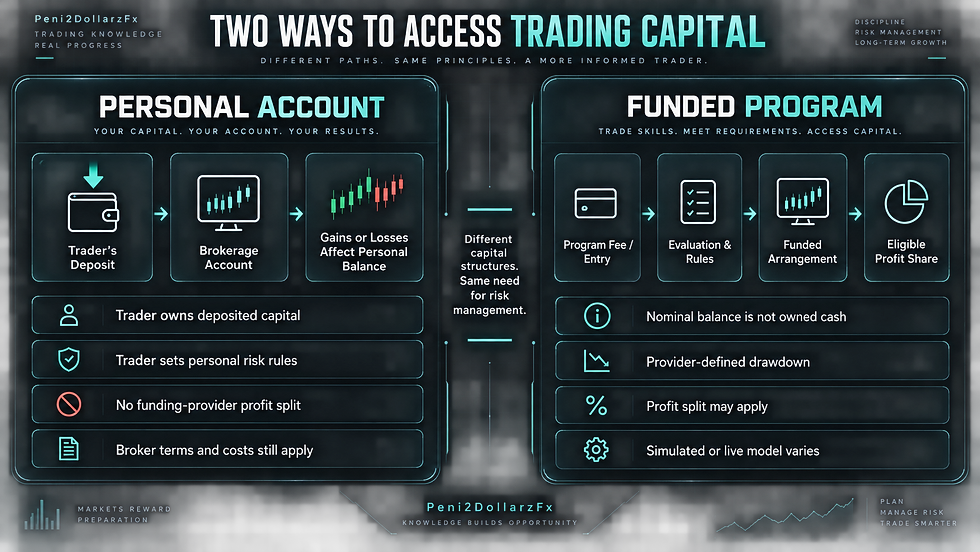
Both routes provide access to a trading environment, but they do so in fundamentally different ways. With a personal trading account, your own money funds the account and your decisions directly affect your balance. With a funded program, you normally trade within a provider's evaluation and contractual structure, subject to its rules, loss limits and payout conditions.
Neither structure creates a profitable strategy. Each changes the trader's costs, flexibility, usable risk and psychological pressure. Understanding those differences is more useful than searching for a universal winner.
What Is a Personal Trading Account?
A personal trading account is an account that you fund with your own money through a broker or trading platform. You decide how much to deposit, how much to risk and—within the broker's terms—which markets and trading style to use.
Profits increase your equity; losses reduce it. There is normally no third-party evaluation target or profit split, but spreads, commissions, swaps, slippage, taxes and other costs may apply. Broker restrictions and leverage limits may also apply.
Imagine depositing $1,000. If the account gains 10%, its balance becomes approximately $1,100 before applicable costs. If it loses 10%, approximately $100 has been lost. The example is deliberately simple: actual results depend on execution, position sizing, fees and changing market prices.
The main attraction is control. The main risk is equally direct: it is your capital absorbing every trading loss.
Personal Trading Account: Potential Advantages
Full control over risk decisions
You generally decide your risk per trade, daily stop, maximum drawdown and when to pause. That freedom is valuable only if it is supported by discipline. Freedom without a risk plan can become overexposure.
No evaluation target
There is usually no requirement to generate a certain return merely to qualify. You can focus on process rather than passing a challenge within prescribed conditions.
No funding-provider profit split
You generally retain your trading profits, after applicable trading costs and taxes. There is no funding provider taking a contractual share.
Greater flexibility
Depending on the broker and account, you may have more freedom to hold overnight or over a weekend, trade during news, choose position sizes or use a particular strategy. This is not unlimited freedom: broker, platform, instrument and regulatory restrictions still matter.
Direct feedback from real financial risk
Trading your own money makes the relationship between decisions and capital unmistakable. That can encourage responsibility, but it can also magnify fear, hesitation or emotional interference.
Personal Trading Account: Limitations and Risks
Your loss is personal
If the account loses $100, your personal balance is $100 lower. Only capital you can afford to lose should ever be committed to speculative trading.
Capital may be limited
A smaller account produces smaller monetary gains when risk is kept conservative. That is mathematically normal—not a problem to “fix” by automatically increasing leverage.
Small-account pressure can encourage overleveraging
A trader who wants a $1,000 account to produce a full-time income may take oversized positions, ignore stop-losses or chase unrealistic monthly returns. The account size has not caused the mistake; the income expectation has distorted the risk.
A small account does not need to be forced into producing a large income.
Growth can be slow
Responsible compounding takes time, and results are never guaranteed. A trader using modest risk must accept that account growth may be gradual or negative.
Personal-money psychology is real
Fear of losing savings can cause early exits, skipped setups, moved stops, revenge trading or constant chart-watching. A personal account offers control, but it does not automatically create emotional control.
What Is a Funded Trading Account?
Funded trading does not simply mean someone gives you a large pile of cash to trade however you want.
A typical process may look like this:
The trader selects a funding program.
The trader pays an evaluation or entry fee, if required.
The trader follows the provider's rules and attempts to meet its conditions.
A successful trader progresses to another evaluation stage or a funded arrangement.
Trading continues under provider-defined risk and operational rules.
Eligible profits may produce a payout according to the contract and profit split.
The exact model matters. Some providers use simulated accounts, some may route or copy selected activity, and others may use different contractual or live-market arrangements. The number advertised as the “account size” may therefore be a nominal trading balance, not cash owned by the trader.
Programs can differ in their fees, profit targets, drawdown method, daily loss limit, minimum trading days, news restrictions, overnight or weekend rules, maximum position size, permitted strategies, consistency rules, scaling plans, platforms and payout conditions. Their terms can also change. Read the provider's current rules and contract before paying a fee or placing a trade.

Funded-Account Terms Every Beginner Must Understand
Profit target
A profit target is the gain a trader must achieve to complete an evaluation stage. For example, an 8% target on a nominal $100,000 account would equal $8,000 in a simplified calculation. It is an assessment condition, not a promise of earnings or a reason to take excessive risk.
Maximum drawdown
Maximum drawdown is the provider-defined loss boundary that the account must not breach. In a simplified hypothetical example, a $100,000 nominal account with a 10% maximum drawdown has a $10,000 drawdown threshold.
That does not mean $10,000 is safe to risk on one trade. It is the total permitted loss boundary under the simplified example.
The calculation method is critical. A limit may be based on starting balance, current balance, equity, intraday equity, end-of-day values or a trailing high-water mark. Open losses may count. Some thresholds remain fixed; others move as the account reaches new highs. A trader must understand the exact formula and reset time, not just the headline percentage.
Daily loss limit
A daily loss limit restricts how much may be lost within the provider's defined day. It is separate from overall maximum drawdown. A trader might remain above the overall threshold yet still violate the daily limit because of closed losses, floating losses, commissions or the provider's calculation method.
Profit split
A profit split determines how eligible profits are divided. If a hypothetical agreement gives the trader 80% of an eligible $1,000 profit, the trader's share would be $800 before any applicable taxes or other adjustments. The percentage, eligibility rules and calculation basis vary.
Evaluation fee
The fee is a real cost. It should not be mentally reframed as purchasing ownership of a $100,000 account. Refund or credit policies, if offered, are provider-specific and conditional.
Trading restrictions
Rules may cover news trading, overnight and weekend exposure, lot size, expert advisers, copy trading, prohibited strategies, consistency, minimum trading days and platform use. A strategy can be sensible in isolation yet incompatible with a particular program.

Funded Account: Potential Advantages
Access to larger nominal capital
A funded structure may let a trader operate within a larger nominal account than they could personally deposit. However:
A $100,000 funded account does not mean the trader owns $100,000 or can lose $100,000.
Its practical risk capacity is constrained by the drawdown, daily limits and contract. A $100,000 headline balance with a $10,000 loss boundary behaves very differently from $100,000 of unrestricted personal capital.
Lower initial personal-capital requirement
The trader may pay a fee rather than depositing the full nominal balance. Their direct financial exposure may therefore be lower than personally funding that headline amount, but repeat fees, subscriptions, resets and related costs can accumulate.
Structured risk limits
Predefined limits can reinforce discipline by placing hard boundaries around losses. The same rules can also create pressure, especially if they conflict with a strategy's normal drawdown or holding period.
Potential profit-sharing opportunity
If the trader meets the conditions, generates eligible profits and satisfies payout rules, they may receive a contractual share. A payout is conditional, not guaranteed.
Funded Account: Limitations and Risks
Evaluations cost money and can be failed
The fee is at risk even if the trader never reaches the funded stage. Repeated attempts can turn a seemingly small fee into a material cumulative loss.
Targets can distort behaviour
The desire to pass quickly may encourage overtrading, oversized positions or lower-quality setups. A target should not replace a tested process.
Drawdown rules can be unforgiving
A trade can violate a rule because of floating loss, slippage, commissions or the provider's reset time—even if the trader's longer-term idea later proves correct. Operational compliance matters as much as market direction.
Trading freedom may be narrower
Restrictions may conflict with news strategies, swing trading, automated systems or variable position sizing. The relevant question is whether the rules fit the strategy.
Profits are shared and payouts are conditional
The trader may not retain all eligible profits. Minimum profitable days, consistency requirements, withdrawal schedules, identity checks or other conditions may apply.
Provider and contractual risk exist
Platforms, execution environments, terms, pricing, payout processes and business continuity differ. Rules may change subject to the contract. Traders should review the legal entity, current terms, payment conditions, dispute process and operational history rather than relying on social-media promotion.
Nominal size can create false confidence
A six-figure label can encourage six-figure thinking. In practice, the loss boundary—not the headline balance—is often the more relevant constraint for risk planning.
Funded Account vs Personal Account: Side-by-Side Comparison
Factor | Personal trading account | Funded trading account |
Capital source | Trader's own deposit | Funding-program structure |
Initial capital requirement | Trader chooses the deposit | Usually a fee or program cost plus provider terms |
Personal money at risk | Directly exposed to trading losses | Commonly fees and related costs; exact exposure depends on the agreement |
Ownership of headline balance | Trader owns deposited funds, subject to broker custody and terms | Trader generally does not own the nominal advertised balance |
Profit retention | Trader generally retains profits after costs and taxes | Profit split and eligibility conditions may apply |
Profit target | Usually none | Often applies during evaluation |
Maximum drawdown | Trader sets a personal limit | Provider defines and calculates it |
Daily loss limit | Self-imposed or broker-dependent | Often provider-defined |
Trading restrictions | Usually broker and market dependent | Often more extensive and provider-specific |
Flexibility | Generally higher | Depends on program rules |
Psychological pressure | Personal-money pressure | Evaluation, target and rule pressure |
Scaling | Depends on deposits and account growth | May be available under provider rules |
Counterparty considerations | Broker, custodian and platform | Provider, broker/platform and contract model |
The table describes structural differences. It does not determine which account is suitable for a particular person.

funded account vs personal account
A Numerical Example: Account Size Is Not Risk Capacity
Consider two hypothetical routes.
Route A: $1,000 personal account
Starting capital: $1,000
Planned risk per trade: 1%
Approximate maximum planned loss per trade: $10, excluding slippage and costs
The trader controls the rule. If equity falls, a true percentage-based position calculation would normally reduce the dollar risk. Nothing external forces the trader to stop at $10; discipline does.
Route B: $100,000 nominal funded program
Nominal account: $100,000
Hypothetical maximum drawdown: 10%
Simplified total drawdown threshold: $10,000
The $10,000 figure is a breach boundary in this simplified example—not a suggested position size and not personal cash belonging to the trader. The provider may also impose a separate daily limit and may calculate drawdown from equity or a trailing reference.
If this trader also chose a 1% risk calculation based mechanically on the $100,000 headline, that would equal $1,000 per trade. Ten full losses could consume the entire simplified drawdown allowance before costs; fewer could do so if other restrictions or a trailing method applied. This illustrates why risk should be designed around the strategy, losing streak, daily limit and drawdown formula—not copied from the nominal balance.
The central lesson is:
Account size ≠ usable risk capacity ≠ recommended position size

The Psychology Is Different—But It Does Not Disappear
Personal-account psychology
The internal message is often: “I am risking my own money.”
That can lead to sensible caution, but also fear, early exits, hesitation, stop movement or revenge trading after a personal loss. A trader may protect each dollar so emotionally that they stop following their tested plan.
Funded-account psychology
The internal message may become: “I need to pass this challenge.”
That can create profit-target pressure, overtrading, increased size, rushed loss recovery or rule-breaking. A deadline or target can make a patient trader behave as if every session must produce a result.
Changing the capital source does not remove the need for:
A tested strategy
Defined risk per trade and per day
Patience during low-quality conditions
Acceptance of normal losing streaks
Accurate record-keeping
Emotional control
The best psychological environment is not necessarily the one that feels exciting. It is the one in which the trader can repeat a sound process without being pushed into avoidable decisions.

5 Funded-Account Myths Beginners Need to Stop Believing
Myth 1: “A $100K funded account means I have $100K”
The headline number is normally a nominal account balance within a program. The trader's actual operating boundary is shaped by drawdown, daily limits and contractual conditions. They do not simply own the advertised amount.
Myth 2: “Funded accounts eliminate the risk of losing money”
Fees, resets, subscriptions or repeated evaluations can be lost. Time and emotional energy also have a cost. The provider's structure may limit direct market-capital exposure, but it does not eliminate financial risk.
Myth 3: “I should hit the target as quickly as possible”
Speed is not evidence of skill. Rushing can increase risk and reduce setup quality. The evaluation rules and any time conditions should be understood before trading.
Myth 4: “A bigger account means I should trade bigger positions”
Position size should follow defined trade risk, stop distance, drawdown limits and strategy statistics. The headline balance alone is insufficient.
Myth 5: “Passing proves I am consistently profitable”
Passing shows that a trader met certain conditions during a particular sample. Consistency requires evidence across different market conditions, a meaningful number of trades and disciplined risk over time.
A Neutral Decision Framework
A personal account may be considered by someone who values direct ownership of deposited capital, flexibility, no evaluation target and control over risk rules.
A funded program may appeal to someone who values access to a larger nominal environment, externally defined limits and a structured qualification process without depositing the full headline balance.
Those are characteristics, not recommendations. Before choosing either route, ask:
Do I have a clearly defined and tested strategy?
Do I know my risk per trade, daily stop and maximum acceptable drawdown?
Can I follow my rules after several consecutive losses?
Do I understand leverage, margin, slippage and trading costs?
Can I afford to lose every dollar I commit in deposits or fees?
Does my strategy fit the account's trading and holding rules?
Have I read the complete current funding contract, drawdown formula and reset times?
Do I understand payout eligibility, profit splits and withdrawal conditions?
Am I choosing this structure because it fits my process—or because I want fast money?
Have I forward-tested the strategy before risking meaningful capital?

Avoid the “Which Is Better?” Trap
There is no universal answer. The two structures solve different problems.
A personal account primarily provides control over the trader's own capital. A funded program can provide access to a larger nominal trading environment under predefined conditions.
The useful question is not “Which one is better?” It is:
Which structure matches my capital, risk tolerance, trading strategy, discipline and ability to follow the rules?
If neither structure fits a tested process, choosing an account type is premature. A demo environment may be more appropriate while the process is still being built—although simulated performance cannot fully reproduce the emotions and execution of live trading.
A Practical Beginner Action Plan
Step 1: Learn the market fundamentals
Understand order types, leverage, margin, spreads, commissions, swaps, volatility and slippage before focusing on account size.
Step 2: Build one clear approach
Define the market, timeframe, setup, entry trigger, invalidation, exit and conditions under which no trade should be taken.
Step 3: Backtest it
Test the rules across a meaningful sample and different market conditions. Avoid changing the rules whenever the results become uncomfortable.
Step 4: Forward-test or paper trade
Observe whether the strategy can be executed in real time. Record missed trades, execution errors and emotional decisions—not just profits and losses.
Step 5: Track the statistics
At minimum, monitor:
Win rate
Average win and average loss
Risk-to-reward outcomes
Expectancy
Maximum drawdown
Longest losing streak
Rule violations
Trading costs
Step 6: Compare the structures
Estimate how the strategy would behave under both models. Would its normal losing streak violate the funded program? Would trading personal money cause unaffordable loss? Do holding times conflict with restrictions? Can all fees be treated as money that may be lost?
Account selection should follow the development of basic trading discipline—not come before it.
Final Takeaway
The account structure does not create the edge. The trader's process does.
A funded account does not automatically make someone a professional trader. A personal account does not automatically make someone safer. Both involve risk, cost, responsibility and psychological pressure; they simply distribute those factors differently.
Before committing capital, understand what you own, what you can lose, how drawdown is calculated, which rules apply and what must happen before a profit becomes a withdrawable payout. Then judge the structure against evidence from your own trading process—not the size of an advertised balance.
Continue Learning With Peni2DollarzFx
Explore more Peni2DollarzFx education on risk management, drawdown, trading psychology and market structure. For ongoing educational discussion and market-learning resources, join the Peni2DollarzFx Discord community. The goal is not to chase a shortcut; it is to build a clearer, more disciplined process.
Disclaimer
Peni2DollarzFx content is for educational and informational purposes only and is not financial, investment or trading advice. Trading leveraged financial markets involves significant risk, and losses can exceed expectations. Readers should conduct their own research and consider their circumstances before committing capital. Funding-program rules, fees, payout structures and account models can change; verify current terms directly with the provider.



Comments