
Oil Market 2026 Explained: Why Crude Surged, Why It Dropped, and What Traders Should Watch Next


Oil is not just another commodity.
It is the fuel behind transportation, manufacturing, shipping, airlines, food supply chains, military operations, inflation, and even central bank decisions. When oil moves sharply, the impact does not stay inside the energy market. It spreads into forex, gold, stocks, bond yields, consumer prices, and global economic confidence.
That is why the 2026 oil market has become one of the biggest stories for traders.
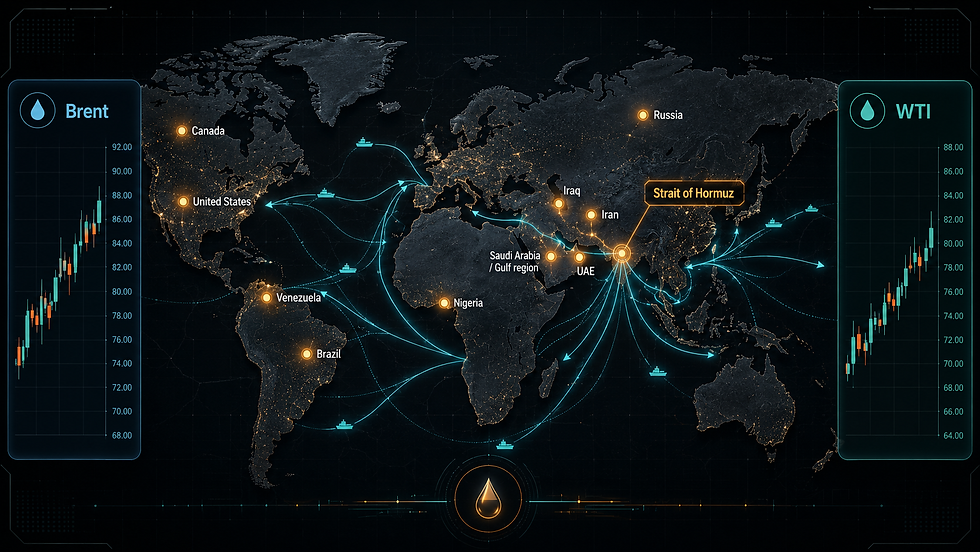
At the start of the year, many analysts were focused on the possibility of extra supply and slower demand. But once Middle East tensions escalated, especially around Iran, Israel, the United States, and the Strait of Hormuz, the entire oil market changed. Brent crude surged above major psychological levels, WTI followed, and traders started pricing in one of the most serious energy supply risks in years.
Then, just when the market looked extremely bullish, oil prices dropped sharply again after diplomatic headlines suggested possible progress between the United States and Iran. On May 25, 2026, Brent crude fell below $100 as markets reacted to hopes of a potential peace framework and possible reopening of the Strait of Hormuz, although uncertainty remained very high.
This is the important lesson:
Oil does not only move on supply and demand. It also moves on fear, headlines, expectations, and positioning.
For traders, understanding this is critical.
1. Introduction — Why Oil Matters Globally
Oil is called the “lifeblood” of the global economy because so many industries depend on it.
When oil becomes more expensive, transportation costs rise. Shipping costs rise. Airline fuel costs rise. Manufacturing costs rise. Food delivery costs rise. That can push inflation higher because businesses often pass those higher costs to consumers.
For beginner traders, the simplest way to understand oil is this:
Oil is both a commodity and a macroeconomic signal.
It tells traders something about:
global growth
inflation pressure
geopolitical risk
supply chain stress
central bank policy
consumer spending
risk sentiment in markets
When oil rises because demand is strong, that can signal economic strength. But when oil rises because supply is disrupted by war, that can be dangerous because prices rise while economic confidence falls.
That second situation is what traders call a supply shock.
Beginner Term: Brent Crude
Brent crude is the main international oil benchmark. It is used to price much of the world’s traded oil, especially oil linked to Europe, Africa, and the Middle East.
Beginner Term: WTI Crude
WTI, or West Texas Intermediate, is the main U.S. oil benchmark. It usually trades differently from Brent because it is more connected to U.S. supply, inventories, pipelines, and refinery demand.
Why traders watch both
If Brent rises faster than WTI, it can mean international supply is under more pressure than U.S. supply. In 2026, this spread became important because disruption around the Strait of Hormuz affected global seaborne oil flows more directly than domestic U.S. oil logistics.

2. What Caused Oil Prices to Surge
Oil prices surged because the market began pricing in a real threat to global energy supply.
The biggest driver was the escalation of conflict involving Iran, Israel, and the United States, combined with severe disruption around the Strait of Hormuz. The International Energy Agency described the Middle East war as creating the largest supply disruption in the history of the global oil market, with crude and oil product flows through the Strait of Hormuz falling sharply from around 20 million barrels per day before the war.
That matters because oil traders do not wait for the full damage to appear.
They react immediately to risk.
When traders see a possible disruption to a major supply route, they start asking:
What if tankers cannot move?
What if insurance costs explode?
What if Gulf producers cannot export normally?
What if inventories fall faster than expected?
What if central banks face another inflation shock?
This is why oil can jump quickly even before the physical shortage is fully visible.
In April 2026, the U.S. Energy Information Administration said Brent crude reached a high of $138 per barrel on April 7 as the de facto closure of the Strait of Hormuz tightened global oil supplies. The EIA also expected global oil inventories to fall sharply in the second quarter, keeping Brent prices elevated around May and June.
That was not a normal oil rally.
It was a geopolitical supply-risk rally.
The main reasons oil surged
Oil moved higher because several bullish forces hit the market at the same time:
Strait of Hormuz disruption reduced confidence in global shipping flows.
Iran-Israel-US tensions created fear of a wider regional war.
Inventories started falling quickly, showing real physical stress.
OPEC+ supply decisions became harder to interpret because some producers could not fully deliver oil even if quotas increased.
Traders added a risk premium because the market had to price uncertainty.
Inflation fears returned, increasing demand for inflation-sensitive assets.
Beginner Term: Risk Premium
A risk premium is extra price added because traders are worried something bad could happen.
For example, if oil would normally trade at $80 based on supply and demand, but war risk makes traders afraid of shortages, oil might trade at $100. That extra $20 is the market’s way of pricing fear and uncertainty.

3. The US-Iran-Israel Conflict Explained
The 2026 oil shock cannot be understood without understanding the geopolitical backdrop.
Iran is one of the most important countries in global energy geopolitics. It has oil reserves, regional influence, and direct access to the Strait of Hormuz. Israel is a major U.S. ally in the Middle East, and tensions between Israel and Iran have long been a source of regional instability.
When conflict escalated into direct military and diplomatic confrontation involving Iran, Israel, and the United States, oil markets immediately focused on one key question:
Could this conflict interrupt global oil supply?
The answer was yes.
Not because all oil production stopped everywhere, but because the conflict threatened the routes, infrastructure, and confidence needed to move oil safely from producers to buyers.
This is where many beginner traders make a mistake. They think oil only rises when production is directly destroyed. In reality, oil can rise when shipping becomes unsafe, insurance becomes expensive, tanker traffic slows, or buyers struggle to secure reliable supply.
In 2026, the market was not only pricing barrels lost today. It was also pricing the possibility of worse disruptions tomorrow.
That is why headlines moved oil aggressively.
A single diplomatic headline could push oil down.
A single attack headline could push oil up.
A single statement about Hormuz could change the entire trading session.
This is how institutional traders think:
They are not only asking, “What happened?”
They are asking, “What could happen next, and is the market underpricing that risk?”

4. Why the Strait of Hormuz Is So Important
The Strait of Hormuz is one of the most important chokepoints in the world.
It is a narrow waterway between Iran and Oman. A large amount of global oil and liquefied natural gas moves through this route from Gulf producers to global buyers, especially in Asia.
The International Energy Agency said oil and product flows through the Strait of Hormuz were around 20 million barrels per day before the war, before plunging during the conflict.
This is why traders care so much.
If the Strait of Hormuz becomes unsafe or effectively closed, oil from major producers can struggle to reach the market. Some supply can be rerouted through pipelines, but not enough to fully replace normal tanker flows.
Think of the Strait of Hormuz like a major highway for global energy.
If one small road is blocked in a city, traffic can move around it.But if the main highway into the city is blocked, everything slows down.
Oil works the same way.
Why Hormuz disruption affects prices so strongly
The Strait matters because it affects:
crude oil exports
refined fuel flows
LNG shipments
tanker availability
insurance costs
delivery timing
refinery planning
global inventory levels
Reuters reported that India shifted more oil purchases toward Latin America and Africa because Middle East supply routes were disrupted, while some Gulf supplies remained hindered because of reliance on the Hormuz route.
That shows the problem clearly:
When one key route becomes unreliable, buyers start searching globally for replacement barrels.
That creates competition, higher freight costs, and more volatility.

5. How Fear and Supply Shocks Move Oil
Oil is extremely sensitive to fear because the world needs a constant flow of energy.
Unlike some products, oil cannot easily be replaced overnight. If supply is disrupted, countries and companies cannot instantly switch to another fuel source. Airlines still need jet fuel. Trucks still need diesel. Factories still need energy. Ships still need fuel.
That is why oil markets react fast.
Beginner Term: Supply Shock
A supply shock happens when the market suddenly fears that supply may drop sharply.
This can happen because of:
war
sanctions
shipping disruptions
pipeline attacks
refinery outages
hurricanes
political instability
OPEC production cuts
A supply shock is different from a normal demand-driven rally.
When oil rises because demand is strong, it can be a sign of economic growth. But when oil rises because supply is threatened, it can become inflationary and economically painful.
How wars affect crude oil
Wars affect crude oil in several ways:
Production risk
Oil fields, refineries, ports, or pipelines may be damaged.
Shipping risk
Tankers may avoid dangerous zones, reducing supply availability.
Insurance risk
War-risk insurance can become very expensive, raising transportation costs.
Sanctions risk
Governments may restrict exports, imports, payments, or shipping services.
Inventory risk
Countries and companies may start hoarding supply, tightening the market.
Psychology risk
Traders may bid prices higher because they fear the worst-case scenario.
This is where oil becomes a headline-driven market.
In a calm market, traders focus on weekly inventories, refinery runs, demand forecasts, and OPEC policy. In a crisis market, traders also focus on military headlines, speeches, diplomatic statements, shipping data, and satellite imagery.
What this means for retail traders
Retail traders must understand that oil can move violently during geopolitical crises.
A setup that looks perfect on the chart can fail within minutes if a major headline drops. This is why risk management matters more than prediction.
For retail traders, the goal is not to guess every headline.
The goal is to:
reduce lot size during high volatility
avoid overleveraging around major news
respect stop losses
avoid revenge trading after spikes
understand that spreads can widen
wait for cleaner confirmation after emotional candles
6. Why Oil Prices Started Falling Again
After oil surged, prices later dropped because traders started pricing in the possibility of de-escalation.
On May 25, 2026, oil prices fell sharply below $100 after optimism grew around possible U.S.-Iran diplomatic progress. The market reacted to hopes that the conflict could move toward a peace framework and that the Strait of Hormuz could eventually reopen more safely.
This does not mean the oil crisis was fully solved.
It means the market reduced part of the fear premium.
Remember, when oil rises sharply during conflict, part of the price is based on real supply disruption and part of the price is based on fear of worse outcomes. If traders believe the worst-case scenario is becoming less likely, they start removing some of that fear premium.
That can make oil fall even if the physical market is still tight.
Why prices dropped despite ongoing risk
Oil dropped because of:
hopes for diplomacy
expectations of partial reopening of shipping flows
traders taking profit after a strong rally
reduced fear of immediate escalation
improved risk sentiment in equities
expectations that supply could gradually normalize
possible OPEC+ output increases
However, analysts remained cautious because even if diplomacy improves, oil flows may not normalize instantly. The EIA said it expected flows through the Strait of Hormuz to slowly resume in late May or early June, but also warned that many pre-conflict production and trade patterns may take until late 2026 or early 2027 to normalize.
That is a key point for traders:
Oil can drop on hope, but it needs real physical supply recovery to stay lower.

7. How Oil Impacts Forex, Gold, Stocks, and Inflation
Oil does not move alone.
It affects almost every major asset class.
Oil and inflation
When oil rises, inflation pressure can increase because energy is used across the economy.
Higher oil can raise:
fuel prices
airline costs
shipping costs
food transportation costs
manufacturing costs
electricity costs in some regions
This can make central banks more cautious. If inflation rises again, central banks may delay rate cuts or even consider tighter policy.
That matters for forex traders because interest rate expectations move currencies.
Oil and interest rates
Central banks do not usually raise rates just because oil rises for one week. But if higher oil prices feed into broader inflation, wages, and consumer expectations, central banks may become more hawkish.
A hawkish central bank means it may keep rates higher for longer.
Higher rates can support a currency, but they can also hurt stocks and slow economic growth.
Oil and forex markets
Oil can affect currencies in different ways.
Oil-exporting currencies
Countries that export oil may benefit from higher oil prices.
Examples include:
Canadian dollar
Norwegian krone
some Gulf-linked currencies
Russian ruble, where accessible and relevant
Mexican peso, partially through energy and risk channels
For example, when oil rises, traders often watch USD/CAD because Canada is a major oil producer. Higher oil can support CAD, although interest rates, risk sentiment, and U.S. dollar strength also matter.
Oil-importing currencies
Countries that import large amounts of oil may suffer when oil rises because their import bills increase.
Examples include:
Japanese yen
Indian rupee
Pakistani rupee
Turkish lira
many emerging-market currencies
Higher oil prices can pressure these currencies because the country needs more dollars to pay for energy imports.
Oil and gold
Gold often rises during geopolitical fear because traders see it as a safe-haven asset.

9. Bullish Scenario for Oil
tanker tracking data
inventory reports
Brent calendar spreads
refinery margins
options pricing
shipping insurance rates
OPEC+ compliance
diplomatic failure headlines
If physical supply remains tight while traders become too optimistic about peace, oil could rebound sharply.

10. Bearish Scenario for Oil
A bearish scenario means oil prices could continue falling.
This does not require everything to become perfect. Oil can fall if the market believes the worst-case scenario is becoming less likely.
Oil could turn bearish if:
A credible peace agreement is signed
A real deal could remove a large part of the geopolitical risk premium.
Hormuz shipping gradually resumes
Even partial normalization could reduce panic.
Inventories stop falling
If stockpiles stabilize, traders may become less bullish.
OPEC+ or non-OPEC supply increases
More supply from the U.S., Brazil, Guyana, Africa, or other producers could reduce pressure.
Global demand weakens
High prices can destroy demand. Airlines fly less, consumers drive less, and factories reduce activity.
Recession fears increase
Oil can fall if traders believe global growth will slow sharply.
The U.S. dollar strengthens
A stronger dollar can pressure commodities because oil is priced in dollars.
Institutional trader view
Institutions may become bearish if they see:
lower spot premiums
weaker refinery margins
slower physical buying
rising inventories
falling freight stress
lower implied volatility
weaker demand forecasts
stronger diplomatic credibility
The most important bearish signal would be this:
Not just good headlines, but actual improvement in oil flows.

11. What Traders Should Watch Next
Oil traders should not only watch the chart.
In a market like 2026, the chart is only one part of the story. The bigger story is macro, geopolitics, supply, and positioning.
1. Strait of Hormuz shipping flows
This is the most important factor.
If tankers move safely again, fear premium may fall. If flows remain restricted, oil may stay supported.
2. U.S.-Iran diplomatic headlines
Traders should watch whether talks produce real agreements or only temporary optimism.
The market can rally or drop quickly based on:
ceasefire language
reopening terms
nuclear negotiation progress
sanctions discussions
military statements
shipping guarantees
3. Inventory data
Watch weekly and monthly inventory reports.
Important sources include:
EIA crude inventories
API inventory estimates
IEA monthly oil market reports
OECD stockpile data
floating storage data
Falling inventories usually support oil. Rising inventories usually pressure oil.
4. OPEC+ production decisions
Do not only watch the headline quota number.
Ask:
Can they actually deliver the barrels?
If the answer is no, the market may ignore the quota increase.
5. Brent-WTI spread
If Brent trades much higher than WTI, it may signal stronger international supply stress.
6. Inflation and central banks
If oil remains high, inflation fears may return. This affects:
U.S. dollar
bond yields
gold
stock indices
emerging-market currencies
7. Global demand signals
Watch demand from:
China
India
Europe
United States
airlines
shipping
manufacturing
petrochemicals
Oil can fall even during conflict if demand destruction becomes severe.
8. Market positioning
If everyone is already bullish, oil becomes vulnerable to sharp pullbacks.
If everyone becomes too bearish while physical supply remains tight, oil can squeeze higher.
What this means for retail traders
Retail traders should treat oil as a high-volatility instrument in 2026.
That means:
use smaller position sizes
avoid trading during major headlines without a plan
mark key levels before entering
wait for candle closes, not just spikes
track both fundamentals and technicals
avoid emotional entries after large moves
respect stop losses
remember that oil can gap aggressively
Oil rewards patience more than panic.

12. Final Thoughts for Traders and Investors
The 2026 oil market is a powerful lesson in how global markets really work.
Oil surged because traders feared a major supply shock from Middle East conflict, especially around Iran, Israel, the United States, and the Strait of Hormuz. The move was supported by real physical concerns, including falling inventories and disrupted shipping flows.
Then oil dropped because markets began pricing in hope: diplomacy, possible de-escalation, and the chance that shipping could gradually normalize.
But the story is not finished.
The key question now is simple:
Will the market get real supply recovery, or only hopeful headlines?
If diplomacy improves and oil flows recover, crude could continue lower as fear premium fades. But if talks fail, Hormuz remains disrupted, or inventories keep falling, oil could regain bullish momentum quickly.
For traders, the goal is not to predict every headline.
The goal is to understand the framework.
Oil moves on:
supply
demand
inventories
OPEC+
geopolitics
inflation
interest rates
market psychology
fear premium
positioning
When all of these forces collide, oil becomes one of the most important markets in the world.
And in 2026, oil is not just telling us about energy.
It is telling us about war risk, inflation risk, global growth risk, and how quickly financial markets can change when the world becomes uncertain.
Trade the market, not the emotion.
Respect the volatility.
Follow the flows.
And never ignore the headlines that can move the barrels.


Comments