
What Is the CLARITY Act, and How Could It Change Crypto Forever?


Introduction: Why the CLARITY Act Matters for Crypto Investors
Imagine building a business where nobody clearly explains the rules — but regulators can still punish you later for breaking them.
That has been one of the biggest problems in the U.S. crypto market for years.
Crypto companies, developers, exchanges, and investors have operated in an environment where the rules were often unclear. One regulator could treat a token as a security, another could view it as a commodity, and many projects were left guessing which laws applied to them.
This uncertainty created fear across the market. It slowed innovation, scared institutions, pushed some crypto companies offshore, and made investors nervous about which assets could face regulatory pressure next.
The CLARITY Act is designed to fix that problem.
The goal is simple: create a clear rulebook for digital assets in the United States.
If passed, the CLARITY Act could become one of the most important crypto laws in U.S. history because it would define how crypto assets are classified, which regulator controls them, and how exchanges, DeFi platforms, stablecoins, and token projects must operate.
Important: The CLARITY Act is not law yet. As of June 2026, it has passed the U.S. House and advanced through the Senate Banking Committee, but it still needs further Senate action, reconciliation with the House version, and final approval before it can be signed into law.
Quick Facts
Detail | Information |
Full Name | Digital Asset Market Clarity Act of 2025 |
Bill Number | H.R. 3633 |
Introduced | May 29, 2025 |
Passed the U.S. House | July 17, 2025 |
House Vote | 294–134 |
Senate Banking Committee Vote | 15–9 on May 14, 2026 |
Current Status | Not law yet |
Main Purpose | Clarify whether digital assets are regulated by the SEC, CFTC, or banking regulators |
The Problem: Why Was the CLARITY Act Created?
For years, the biggest regulatory question in crypto has been:
Is this token a security or a commodity?
That one question affects almost everything.
If a token is treated as a security, it falls mainly under the SEC.If a token is treated as a commodity, it falls mainly under the CFTC.If it is a payment stablecoin, it may fall under banking regulators.
The problem is that the U.S. did not have one clear framework explaining where every digital asset fits.
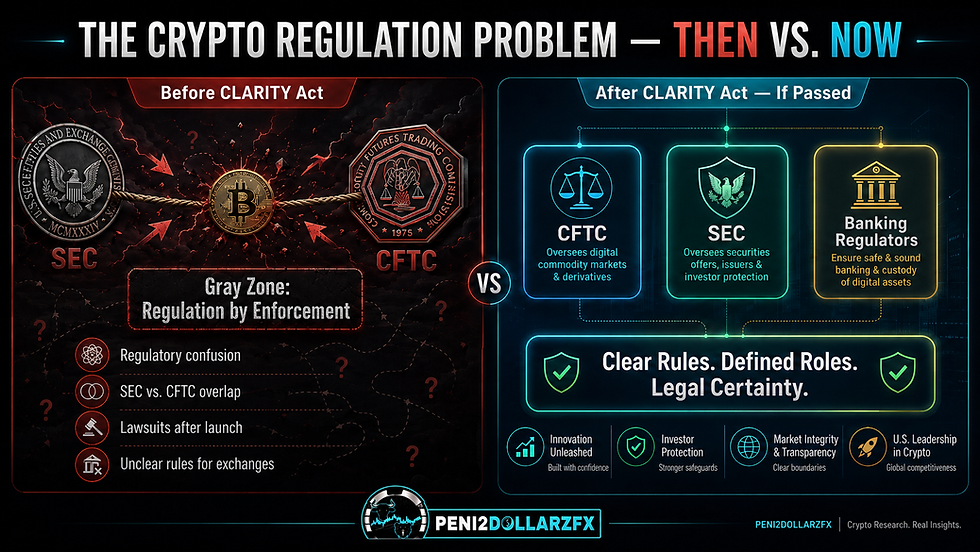
Because of that, the crypto industry faced what many people call regulation by enforcement.
That means instead of giving clear rules first, regulators often brought lawsuits after companies had already launched products or tokens. This created confusion for builders, exchanges, institutions, and retail investors.
The CLARITY Act attempts to replace that confusion with a written legal framework.
Instead of guessing the rules, the industry would have clearer categories, clearer regulators, and clearer compliance requirements.
What the CLARITY Act Actually Does
The CLARITY Act creates a classification system for digital assets.
In simple words, it tries to answer:
What type of asset is this token, and who should regulate it?
The bill separates digital assets into three major categories.
Category | What It Means | Main Regulator | Examples |
Digital Commodity | A token connected to a functional and decentralized blockchain network | CFTC | Bitcoin, Ethereum-like assets |
Investment Contract Asset | A token sold by a centralized team or project to raise capital | SEC | Early-stage token offerings |
Payment Stablecoin | A token designed to stay pegged to a currency like the U.S. dollar | Banking Regulators | USDC, USDT-style assets |
This is important because it could finally reduce the long-running debate over whether most crypto assets should be treated like stocks or commodities.
The CFTC would oversee many mature digital commodities. The SEC would continue overseeing securities-like token offerings and investment contract assets. Banking regulators would oversee payment stablecoins under the relevant stablecoin framework.

SEC vs. CFTC: What Changes?
Today, the SEC and CFTC both play important roles in U.S. financial markets, but their responsibilities in crypto have often overlapped.
The CLARITY Act tries to draw a cleaner line between them.
CFTC Role
The CFTC would gain stronger authority over digital commodity spot markets.
That means the CFTC would regulate platforms where users directly buy and sell mature digital commodities such as Bitcoin and similar decentralized crypto assets.
This could include oversight of:
Digital commodity exchanges
Digital commodity brokers
Digital commodity dealers
Trading rules
Customer protection standards
Market integrity requirements
SEC Role
The SEC would still regulate assets that look like securities or investment contracts.
This includes tokens sold by centralized teams to raise money, especially if buyers expect profit mainly from the work of that team.
The SEC would also keep important anti-fraud authority and oversight over securities-related digital asset activity.
Banking Regulators
Payment stablecoins would be treated separately and regulated under banking-style rules.
That matters because stablecoins are not mainly used for speculation. They are often used for payments, settlements, trading liquidity, and dollar exposure inside crypto markets.
Why This Matters for Bitcoin
For Bitcoin, the CLARITY Act is generally seen as positive.
Bitcoin is already widely viewed as a commodity, but having that status written more clearly into federal law would create stronger legal certainty.
That matters for large institutions.
Pension funds, asset managers, family offices, banks, and sovereign wealth funds usually do not like regulatory uncertainty. They need legal clarity before allocating serious capital.
If Bitcoin is clearly treated as a digital commodity, it becomes easier for institutions to build products, offer exposure, and hold it within regulated structures.
This does not guarantee price appreciation, but it does remove one major legal barrier.
For long-term Bitcoin adoption, that is important.
Why This Matters for Ethereum
Ethereum is more complicated than Bitcoin because of its early fundraising history and its role as a smart contract platform.
However, Ethereum today is widely viewed as a mature and decentralized network.
If Ethereum qualifies as a digital commodity under the CLARITY Act framework, it would gain stronger regulatory certainty.
That could support:
More institutional ETH products
Stronger confidence in Ethereum ETFs
Greater adoption by regulated financial firms
More comfort around Ethereum-based infrastructure
Higher confidence in Layer 2 and DeFi ecosystems
For Ethereum, the biggest benefit is not only price speculation. It is legitimacy.
A clear commodity-style classification could make Ethereum easier for traditional finance to integrate.
What About Altcoins?
Altcoins will likely be judged case by case.
This is where investors need to be careful.
Not every token will automatically become a digital commodity.
Some projects may still fall under SEC oversight if they have:
A centralized founding team
Heavy insider token ownership
Strong dependence on one company or foundation
Early-stage development
Token sales that look like fundraising
Weak decentralization
Limited real network usage
This means the CLARITY Act could create winners and losers.
Mature, decentralized networks may benefit.Centralized or weak projects may face more pressure.
For investors, this makes token research even more important.
The key question becomes:
Is this project truly decentralized and functional, or is it still mainly dependent on one team?
Impact on Crypto Exchanges
Crypto exchanges could be among the biggest winners and biggest losers.
Large regulated exchanges may benefit because they finally get a clearer registration pathway.
This helps platforms like major U.S. exchanges because they already have compliance teams, legal departments, custody systems, and reporting infrastructure.
But smaller exchanges may struggle.
Compliance is expensive. Registration, reporting, custody standards, anti-money laundering controls, and customer protection systems all cost money.
The CLARITY Act would likely favor exchanges that can operate like serious financial institutions.
For investors, this could be positive because stronger exchange rules may reduce the risk of customer funds being misused.
After collapses like FTX, one major lesson is clear:
Customer assets must be separated from company assets.
The CLARITY Act includes consumer protection and fund segregation requirements, which could make the market safer over time.
Impact on DeFi
DeFi is one of the most important parts of this bill.
The CLARITY Act includes protections for certain non-custodial software developers and decentralized protocols.
In simple words:
If developers only build code and do not control user funds, they should not automatically be treated like banks, brokers, or exchanges.
That matters because DeFi is built on open-source software, smart contracts, wallets, liquidity pools, decentralized exchanges, and on-chain protocols.
However, investors should not misunderstand this.
The bill does not mean all DeFi is completely free from regulation.
If a platform controls user funds, operates like a centralized business, or has a team managing key financial activity, it may still face regulation.
So the real difference is:
Non-custodial software may get protection. Custodial or centralized activity may still be regulated.
This is positive for genuine DeFi builders, but the final details still matter.
Impact on Stablecoins
Stablecoins are handled separately from most crypto assets.
A stablecoin is usually designed to track the value of a fiat currency such as the U.S. dollar.
Examples include USDC and USDT-style assets.
Stablecoins are important because they are used for:
Crypto trading liquidity
Cross-border payments
Dollar exposure
DeFi activity
Settlement between platforms
Moving funds quickly between exchanges
Under the CLARITY Act framework, payment stablecoins would be treated separately under banking regulators, consistent with the broader stablecoin regulatory framework.
One of the most debated issues is whether stablecoin platforms or related service providers should be allowed to offer passive yield or interest-like rewards.
That debate matters because stablecoins compete with bank deposits.
If stablecoins can offer yield, banks may see them as a major threat. If yield is restricted, stablecoins may become more payment-focused and less like savings products.

Bullish Scenario: What Could Go Right?
If the CLARITY Act passes in a strong form, it could be a major long-term catalyst for crypto.
The bullish argument is based on one simple idea:
Institutions need legal clarity before they deploy large capital.
If the law clearly defines digital commodities, gives exchanges a registration path, protects non-custodial DeFi builders, and separates stablecoins into their own framework, the crypto market becomes easier for traditional finance to enter.
A bullish outcome could include:
More institutional investment in Bitcoin and Ethereum
Easier approval path for more crypto ETFs
Stronger confidence in U.S.-regulated exchanges
More serious capital entering crypto infrastructure
Better investor protection
More builders staying in the United States
Reduced fear of surprise enforcement actions
This could be especially positive for Bitcoin, Ethereum, large-cap compliant assets, and major exchanges.
Bearish Scenario: What Could Go Wrong?
The CLARITY Act is not automatically bullish.
There are still risks.
First, the bill could stall or be heavily changed before becoming law.
Second, markets may already price in the good news before the bill passes. That creates a possible buy the rumor, sell the news reaction.
Third, stricter compliance rules could hurt smaller exchanges and early-stage projects.
Fourth, some DeFi rules could become more restrictive depending on final Senate negotiations.
A bearish outcome could include:
The bill gets delayed
The final version becomes weaker or more restrictive
DeFi protections are reduced
Stablecoin rules become too tight
Smaller projects leave the U.S. market
Some altcoins face delistings or legal pressure
Market sells off after the news is already priced in
So investors should avoid thinking:
“Regulation = price goes up immediately.”
The better view is:
Clear regulation can be long-term bullish, but short-term market reaction can still be volatile.

Common Misconceptions
“The CLARITY Act is already law.”
No. It has advanced further than many previous crypto bills, but it is not law yet. It still needs more Senate process, reconciliation, and final approval.
“The SEC will no longer regulate crypto.”
Not true. The SEC would still regulate investment contract assets, securities-like tokens, tokenized securities, and fraud-related activity.
“Every altcoin becomes a commodity.”
No. Altcoins would likely be reviewed case by case. Mature and decentralized networks may benefit, while centralized or early-stage projects may remain under SEC oversight.
“Regulation is always bullish.”
Not always. Clear rules can help long-term adoption, but regulation also creates compliance costs. Some projects may struggle under stricter requirements.
“DeFi will be fully protected.”
Not fully. Non-custodial developers may receive protection, but platforms that control user funds or operate like financial intermediaries may still face regulation.
What Should Crypto Investors Watch Next?
Crypto investors should track the CLARITY Act carefully because regulatory news can move markets.
The most important things to watch are:
1. Senate Progress
The bill still needs to move through the full Senate process. Any delay, amendment, or political opposition can affect market sentiment.
2. House and Senate Reconciliation
The House and Senate versions may not be identical. Differences must be resolved before the final version can become law.
3. DeFi Protections
This is one of the most important areas for builders and investors. Strong DeFi protections would be positive for decentralized protocols.
4. Stablecoin Yield Rules
Rules around stablecoin rewards, yield, and interest-like products could strongly impact stablecoin issuers, exchanges, DeFi platforms, and banks.
5. CFTC and SEC Rulemaking
Even if the law passes, implementation will take time. Regulators will still need to write detailed rules.
6. Altcoin ETF Applications
Clearer classification could make it easier for more spot crypto ETFs to move forward, especially for large-cap assets like Solana, XRP, and Cardano.
7. Market Reaction
Watch whether crypto prices rally before the vote. If the market gets too excited too early, short-term corrections are possible even after good news.
Key Takeaways
The CLARITY Act could become one of the most important crypto laws in U.S. history.
Here is what investors need to remember:
The CLARITY Act is designed to create a clear U.S. rulebook for digital assets.
It separates digital assets into categories such as digital commodities, investment contract assets, and payment stablecoins.
The CFTC would oversee many mature digital commodities.
The SEC would continue overseeing securities-like tokens and investment contract assets.
Banking regulators would oversee payment stablecoins.
Bitcoin and Ethereum are likely among the biggest long-term beneficiaries.
Altcoins will likely be judged case by case.
Large compliant exchanges may benefit, while smaller platforms may face higher costs.
DeFi may receive partial protection, especially for non-custodial software builders.
The bill is not law yet, so investors must continue watching the Senate process.
Final Thoughts
The CLARITY Act is important because crypto does not only move on charts, liquidity, and hype. Crypto also moves on regulation.
For years, one of the biggest risks in the market has been uncertainty. Investors did not know which tokens could be targeted next. Exchanges did not know which assets were safe to list. Developers did not know whether building open-source software could expose them to regulatory pressure.
The CLARITY Act is an attempt to replace that uncertainty with a clearer framework.
It will not solve every problem. It will not make every token safe. It will not remove volatility from the market.
But if passed in a strong form, it could give the crypto industry something it has needed for years:
legal clarity.
For traders, this means regulatory events should now be part of your watchlist.
For investors, this means token fundamentals matter more than ever.
And for the crypto market as a whole, this bill could mark the beginning of a more mature, institutionally accepted phase.
Stay tuned to Peni2Dollarz for updates as the CLARITY Act moves through the next stage. We will continue breaking down major crypto, macro, and market developments in simple language so you can stay one step ahead.
FAQ
Is the CLARITY Act already law?
No. The CLARITY Act has passed the U.S. House and advanced through the Senate Banking Committee, but it still needs further Senate action, reconciliation, and final approval before becoming law.
What is the main purpose of the CLARITY Act?
The main purpose is to create clearer rules for digital assets by defining which crypto assets fall under the SEC, CFTC, or banking regulators.
Is the CLARITY Act bullish for Bitcoin?
Long term, it could be positive because it may strengthen Bitcoin’s status as a digital commodity and make institutional participation easier. However, price movement is never guaranteed.
Is the CLARITY Act bullish for Ethereum?
It could be positive if Ethereum is treated as a mature digital commodity. That would support institutional confidence and could help Ethereum-related financial products.
What happens to altcoins?
Altcoins will likely be reviewed case by case. Decentralized and mature networks may benefit, while centralized or early-stage tokens may remain under SEC oversight.
Will DeFi be protected?
Some non-custodial DeFi developers and software builders may receive protection, but DeFi platforms that control user funds may still face regulation.
Can regulation hurt crypto?
Yes. Clear rules can help long-term adoption, but strict compliance requirements may hurt smaller projects, smaller exchanges, or tokens that cannot meet regulatory standards.
For educational purposes only. Not financial or legal advice. Always do your own research before making investment decisions.


https://soicaulodechuan.mobi/ cái mình để ý đầu tiên là tên tỉnh nằm ngay trên từng cột kết quả, nhìn xuống là biết dãy số nào thuộc chỗ nào. Mình hay đọc lướt nên gặp bảng nhiều số cũng hơi ngại, có tên đặt sẵn như thế thì đỡ phải ngó qua ngó lại. Không cần trình bày gì lạ mắt đâu, chỉ cần lúc tìm một giải không bị lẫn sang tỉnh bên cạnh là thấy tiện rồi. Mình cũng thích có phần đầu, đuôi loto tách ra riêng, lúc muốn xem phần đó thì không phải dò lại từng hàng giải. Cảm giác nội dung được chia vừa đủ, không làm mình phải đoán đang đọc bảng gì. Ở bảng…
keonhacai tối qua mình tranh thủ lướt lúc nghỉ giải lao, kiểu chỉ định xem giao diện ra sao thôi. Vừa vào là mình bắt nhịp khá nhanh vì thanh menu đặt ngay chỗ dễ thấy, bấm qua lại giữa các mục không bị vòng vo nên đỡ phải căng mắt tìm, mà cảm giác trang phản hồi cũng nhanh nên cuộn xuống không bị khựng. Mình cũng không đào sâu nội dung gì, chủ yếu để ý cách họ trình bày: thông tin chia thành các khối gọn gàng, nhìn phát là biết phần nào đang nói về gì, nhất là mấy bảng số liệu xếp theo cột nên liếc một cái là nắm được, không bị rối chữ.…
Bài viết dễ theo dõi, mình đọc một mạch hết luôn, cảm ơn bạn đã chia sẻ. Mình cũng hay theo dõi chủ đề này nên thỉnh thoảng vào xem các nền tảng giải trí trực tuyến để học cách họ chia chuyên mục và bố trí thông tin. Mình đã tự gom lại trên một trang để tiện lưu và xem lại cho gọn. Ai quan tâm thì ghé https://topkif.nvinio.com/Soicauxsmbpro