
How to Identify Trending vs Ranging Markets


A Guide to Reading Market Conditions Before You Trade
Most beginners enter the market with one question:
“Should I buy or sell?”
But professional traders usually ask a better question first:
“What type of market am I looking at?”
This one question can save you from many bad trades.
Why?
Because markets do not always move the same way. Sometimes price moves strongly in one direction. Other times, price moves sideways and becomes confusing.
These two conditions are called:
Trending markets and ranging markets.
Understanding the difference between them is one of the most important skills a beginner trader can learn.
Why This Topic Is So Important for Beginners
Imagine driving a car.
On a clear highway, you can drive smoothly in one direction.
But in a crowded parking lot, you cannot drive fast. You must slow down, wait, and move carefully.
The market works in a similar way.
A trending market is like a clear highway.
A ranging market is like a crowded parking lot.
If you use the same driving style in both places, you will get into trouble.
Trading is the same.
Many beginners lose money because they use a trending strategy in a ranging market, or they try to force trades when the market is not giving clear direction.
This usually leads to:
Overtrading
Entering too early
Getting stopped out again and again
Chasing fake moves
Feeling frustrated
Taking revenge trades
So before you ask, “Buy or sell?”, first ask:
“Is the market trending or ranging?”
What Is a Trending Market?
A trending market is when price is clearly moving in one main direction.
It can move upward or downward.
An uptrend means price is generally moving higher.
A downtrend means price is generally moving lower.
Price does not move in a straight line. It moves in waves.
Even in an uptrend, price will move up, pull back, and then continue higher.
Even in a downtrend, price will move down, pull back, and then continue lower.
That is normal.
Uptrend: Price Moving Higher
In an uptrend, buyers are stronger than sellers.
Price keeps making:
Higher highs
Higher lows
A higher high means price reaches a new high point.
A higher low means price pulls back, but does not fall as low as before.
Simple example:
Price moves from 100 to 110, then pulls back to 105, then moves up to 115.
That is an uptrend because price is climbing step by step.
Think of it like walking upstairs.
You move up one step, pause, then move up again.
Downtrend: Price Moving Lower
In a downtrend, sellers are stronger than buyers.
Price keeps making:
Lower lows
Lower highs
A lower low means price drops to a new low point.
A lower high means price bounces up, but not as high as before.
Simple example:
Price moves from 100 to 90, then bounces to 95, then drops to 85.
That is a downtrend because price is moving down step by step.
Think of it like walking downstairs.
Price drops, pauses, then drops again.

What Is a Ranging or Consolidating Market?
A ranging market is when price is not clearly moving up or down.
Instead, price moves sideways between two areas:
A top area called resistance
A bottom area called support
Resistance is the area where price often struggles to go higher.
Support is the area where price often struggles to go lower.
In simple words:
Price is trapped inside a box.
It goes up, hits the top, falls down, hits the bottom, then goes up again.
This is also called:
Consolidation
Sideways market
Range-bound market
Choppy market
Simple Example of a Ranging Market
Imagine price keeps moving between 100 and 110.
It goes to 110, then falls back to 100.
Then it rises again to 110, then falls again to 100.
Price is not starting a strong trend.
It is moving inside a zone.
This is like a ball bouncing inside a room.
It hits one wall, bounces back, hits the other wall, and repeats.
That is a ranging market.

How Price Behaves in Trending Markets
In a trending market, price usually has a clear direction.
You can often see strong movement.
In an uptrend, price:
Makes higher highs
Makes higher lows
Pulls back, then continues upward
Often respects trendlines or moving averages
Shows stronger bullish candles
In a downtrend, price:
Makes lower lows
Makes lower highs
Pulls back, then continues downward
Often rejects from resistance areas
Shows stronger bearish candles
A trending market feels cleaner.
It does not mean every trade will win, but direction is easier to understand.
Tip
In a trend, do not panic when price pulls back.
A pullback does not always mean the trend is over.
Sometimes price is only taking a short break before continuing.
Think of a runner.
Even a strong runner slows down sometimes.
That does not mean the race is finished.
How Price Behaves in Ranging Markets
In a ranging market, price often looks confusing.
It may move up, then quickly move down.
It may break a small level, then reverse.
It may look like a trend is starting, but then price comes back inside the range.
This is why beginners often lose money during consolidation.
A ranging market can create many fake signals.
Price may look bullish near the top, but then suddenly fall.
Price may look bearish near the bottom, but then suddenly rise.
That is because there is no strong winner between buyers and sellers.
Both sides are fighting.
Simple Way to Understand It
A trending market is like a team clearly winning the match.
A ranging market is like both teams stuck at the same score, fighting back and forth.
No one is fully in control yet.
That is why beginners must be careful.
Visual Characteristics Traders Should Look For
You do not need complicated indicators to identify market condition.
Start with simple observation.
Ask yourself:
1. Is Price Making Higher Highs and Higher Lows?
If yes, the market may be in an uptrend.
Look for price climbing in waves.
Do not focus on one candle only.
Zoom out and look at the bigger picture.
2. Is Price Making Lower Lows and Lower Highs?
If yes, the market may be in a downtrend.
Look for price falling in waves.
Again, do not judge from one candle.
Look at the structure.
3. Is Price Stuck Between the Same High and Low?
If price keeps bouncing between the same top and bottom area, it may be ranging.
This means price is not ready to move strongly yet.
The market is still deciding.
4. Are Breakouts Failing Again and Again?
In a range, price may briefly move above resistance or below support, then quickly return.
This is called a fake breakout.
Beginners often enter these moves too quickly and get trapped.

Why Beginners Lose Money During Consolidation
Consolidation is dangerous for beginners because it looks like opportunity everywhere.
Price moves up, and the beginner thinks:
“This is a buy!”
Then price quickly reverses.
Price moves down, and the beginner thinks:
“This is a sell!”
Then price quickly reverses again.
After a few losses, frustration starts.
Then the beginner may increase lot size, enter randomly, or try to win back losses.
This is how overtrading begins.
The Big Problem
Beginners often think:
“If price is moving, I should trade.”
But professional traders understand:
“Not every movement is worth trading.”
A moving market is not always a good market.
Sometimes the best trade is no trade.
How Profitable Traders Behave in Trending Markets
Professional traders do not randomly chase price.
In trending markets, they usually wait for better entries.
For example, in an uptrend, they may wait for price to pull back to a support area before buying.
In a downtrend, they may wait for price to pull back to a resistance area before selling.
They understand that entering late can be risky.
They want to join the trend at a smarter place.
In an Uptrend, Professionals Often Look For:
Pullbacks
Support areas
Higher lows
Bullish continuation signals
Strong buyer control
They avoid buying too late after price has already moved too far.
In a Downtrend, Professionals Often Look For:
Pullbacks upward
Resistance areas
Lower highs
Bearish continuation signals
Strong seller control
They avoid selling too late after price has already dropped too far.
How Professional Traders Behave in Ranging Markets
In ranging markets, professionals become more selective.
They know the market can be tricky.
They usually do one of three things:
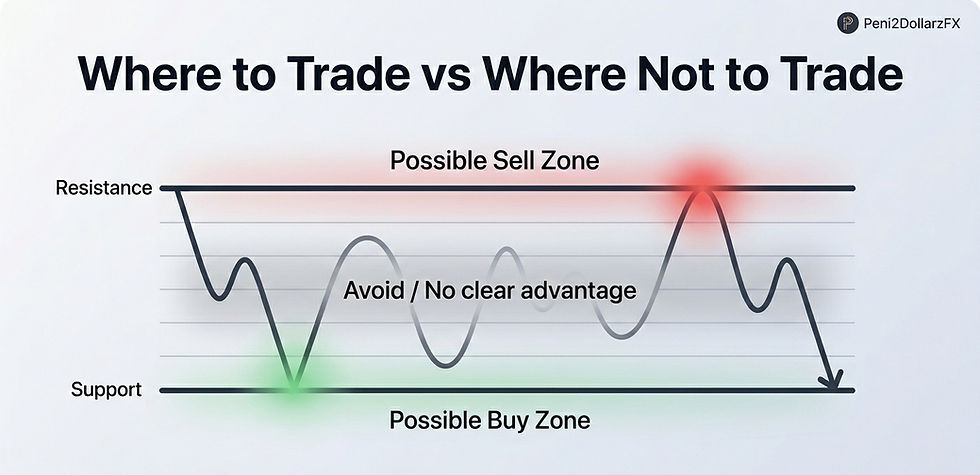
1. Trade From the Edges
They may buy near support and sell near resistance.
But they do this carefully and only when the range is clear.
They do not enter in the middle of the range.
2. Wait for a Real Breakout
Sometimes price breaks out of the range and starts a new trend.
Professionals often wait for confirmation.
They do not enter just because price touched outside the range for one second.
They want to see if price can stay outside the range and continue.
3. Stay Out
This is very important.
Professional traders are not afraid to do nothing.
They know patience is part of trading.
No trade is better than a bad trade.
Best Strategies for Trending Markets
Trending markets are usually better for continuation strategies.
That means you are trying to trade in the same direction as the trend.
In an Uptrend
Beginner-friendly approach:
Identify higher highs and higher lows
Wait for price to pull back
Look for support
Enter only if buyers show strength again
Avoid buying after a huge move without a pullback
Simple idea:
Buy low inside an uptrend, not when price is already too high.
In a Downtrend
Beginner-friendly approach:
Identify lower lows and lower highs
Wait for price to pull back upward
Look for resistance
Enter only if sellers show strength again
Avoid selling after a huge drop without a pullback
Simple idea:
Sell high inside a downtrend, not when price is already too low.
Trend Trading Analogy
Think of a moving train.
You do not want to jump in front of it.
You also do not want to chase it when it is too far away.
You want to wait for it to slow down at a station.
That “station” is like a pullback.
Best Strategies for Ranging Markets
Ranging markets need a different mindset.
You are not looking for strong continuation.
You are looking for price to bounce between two areas.
Beginner-Friendly Range Strategy
First, identify clear support and resistance.
Then:
Look for buys near support
Look for sells near resistance
Avoid trading in the middle
Be careful with fake breakouts
Use smaller expectations because price may not move far
The middle of the range is usually the worst place for beginners.
Why?
Because price can go either way.
There is no clear advantage.
Range Trading Analogy
Imagine a ball bouncing between the floor and ceiling.
Buying near the ceiling is risky.
Selling near the floor is risky.
The better opportunities are usually near the edges, not the middle.
When NOT to Trade
This is where beginners need the most discipline.
You should consider staying out when:
Price is moving sideways with no clear support or resistance
Price is in the middle of a range
Candles are messy and overlapping
You cannot clearly explain why you are entering
The market already made a big move and you are late
You are emotional after a loss
You are only trading because you feel bored
You are trying to recover money quickly
A simple rule:
If you cannot clearly identify the market condition, do not trade yet.
Waiting is not weakness.
Waiting is protection.
Trending vs Ranging Market: Simple Comparison
Market Type | What Price Does | Beginner-Friendly Meaning | Main Risk |
Uptrend | Higher highs and higher lows | Buyers are mostly in control | Buying too late |
Downtrend | Lower lows and lower highs | Sellers are mostly in control | Selling too late |
Range | Price moves sideways between support and resistance | No clear winner yet | Overtrading and fake breakouts |
Key Takeaways
A trending market moves clearly in one direction.
An uptrend makes higher highs and higher lows.
A downtrend makes lower lows and lower highs.
A ranging market moves sideways between support and resistance.
Beginners often lose money in ranges because price gives many fake signals.
Do not trade every candle.
Do not buy at resistance or sell at support without understanding the market.
In trends, wait for pullbacks instead of chasing price.
In ranges, avoid the middle because price can go either way.
Professional traders know when to trade and when to stay out.
The best trade is sometimes no trade.
Final Beginner Reminder
Trading is not about always being active.
It is about making better decisions.
Before every trade, pause and ask:
“Is this market trending, ranging, or unclear?”
If it is trending, look for trades with the direction.
If it is ranging, be careful and avoid the middle.
If it is unclear, protect your capital and wait.
The market will always give more opportunities.
Your job is not to catch every move.
Your job is to choose the right ones.


Comments