
Crypto & Blockchain Security vs Traditional Banks: Which Is Safer, and Why?

Introduction: Why People Question Crypto Security When most people hear “crypto,” they also hear stories about hacks, scams, and people losing money. Banks, on the other hand, feel familiar. They have buildings, staff, rules, and a long history. So it’s normal to ask: Is crypto really safe, or is it riskier than a bank? But here is the key idea: banks and crypto protect money in very different ways. Banks rely on central control and approval systems. Blockchain relies on math, shared records, and systems designed to be extremely hard to change or fake. Understanding how each works makes it much easier to see where the real security strengths (and risks) are.
How Traditional Banking Security Works (and Why It Feels Safe)

Banks are centralized. That means your money and transaction history are managed by one main organization (the bank) and its connected partners. This system uses layers of protection such as:
1) Identity checks and account controls
Banks protect access by using passwords, PINs, SMS codes, app approvals, biometric login, and fraud monitoring. If the bank thinks something looks suspicious, it can pause a transaction or lock your account to protect you.
Real-life example: If you send a large amount to a new person, your bank may delay it, call you, or block it until you confirm it was really you.
2) Intermediaries and approvals
A bank transfer often passes through multiple systems—your bank, the recipient’s bank, clearing networks, and sometimes international partners. These “middle steps” can add safety checks, but they also add waiting time and extra fees.
Real-life example: You send money on Friday evening and it doesn’t arrive until Monday because of weekends, bank hours, or holidays. International transfers can take even longer.
3) The bank can reverse or freeze transactions
This is a big reason people trust banks: banks can undo certain actions. If your card is stolen, the bank can cancel it. If fraud is detected, the bank can freeze an account.
But this has a trade-off: Because banks control the system, they also have the power to delay, block, reverse, or freeze funds—even if you personally disagree.
How Blockchain and Crypto Security Works (and Why It’s Hard to Fake)
Blockchain is a different kind of system. Instead of one bank controlling the record, many computers share and verify the same record together. That’s what people mean by decentralization: no single organization fully controls the ledger.
Think of blockchain as a shared public record book that updates only when the network agrees.

1) Decentralization: no single point of failure
In a bank system, one central database is a high-value target. If attackers break in (or if a system fails), it can cause widespread damage. In blockchain, the record is spread out across many computers. To fake it, an attacker would need to overpower the network—much harder than attacking a single database.
2) Encryption: sealed digital locks
Encryption is like a digital lock that protects information. In simple terms, it uses advanced math to make sure only the real owner can authorize a transaction.
Real-life analogy: Imagine a sealed envelope that only you can open and sign. Even if someone sees the envelope, they can’t change what’s inside or fake your signature.
3) Transparency: easy to verify
Most public blockchains allow anyone to view transactions. You may not see personal names, but you can see that the transaction happened and track it on the public ledger.
Real-life analogy: Like a public scoreboard that updates in real time—no single person can quietly rewrite it without everyone noticing.
4) Immutability: extremely hard to change history
Immutability means once a transaction is recorded and confirmed, it becomes very difficult to change. That is a major security advantage: it reduces hidden manipulation.
Real-life analogy: Like writing with permanent ink in a notebook that is copied and stored by thousands of people. Changing one page doesn’t change everyone else’s copy.
Quick Comparison: Crypto Transaction vs Bank Transfer

Feature | Traditional Bank Transfer | Crypto/Blockchain Transfer |
Speed | Minutes to days (hours, weekends, holidays can slow it) | Often minutes (sometimes seconds, depending on network) |
Cost | Fees can be higher (especially international) | Often lower, though fees vary by network and congestion |
Transparency | You rely on bank statements and internal tracking | Public record (you can verify transactions on-chain) |
Security model | Central control + approvals + reversals | Math-based ownership + shared verification |
Control | Bank can freeze, delay, reverse in many cases | User-controlled; transactions usually can’t be reversed |
Why Blockchain/Crypto Can Be Harder to Manipulate

Harder to fake the record
Because the transaction history is shared and constantly checked, secretly changing it is extremely difficult. You’re not trusting one company’s database—you’re trusting a system designed to be verified by many participants.
No single point of failure
In banking, a successful attack on one major system can impact many users. In blockchain, the network structure is designed to keep running even if some parts fail.
Protection against certain kinds of fraud
In a blockchain system, you don’t “pretend” money exists or quietly alter balances. Ownership is proven through cryptographic signatures (digital proof that you authorized the transfer). That makes some types of behind-the-scenes manipulation much harder.
Important note: Crypto is not “magic protection.” People can still be tricked, and platforms can still be hacked. But the core blockchain record is built to be extremely resistant to tampering.
“Crypto Is a Scam” Misconception: What’s Really Going On
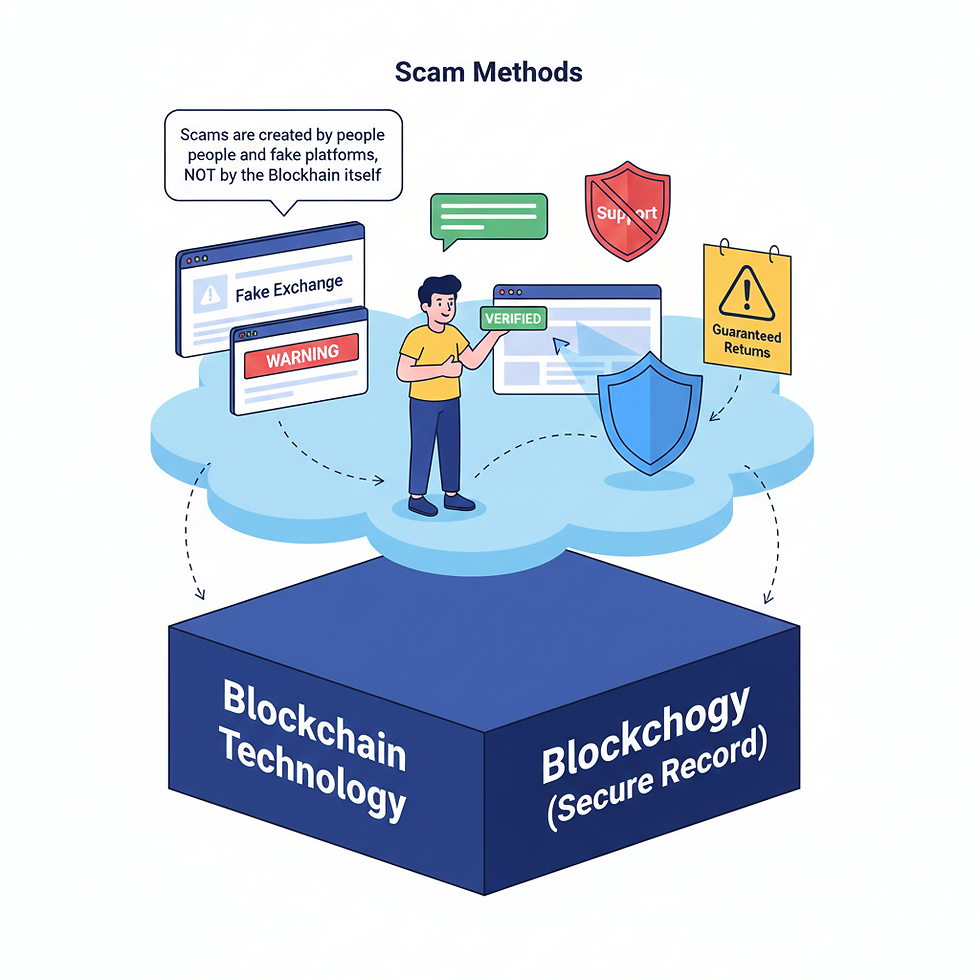
1) Blockchain technology (the system)
Blockchain itself is like the internet or email: it’s a tool. It can be used for good or misused by bad actors.
2) Scams happen around the system, not because of the system
Most “crypto scams” are actually people scams:
Fake investment promises (“guaranteed returns”)
Impersonation (“customer support” scammers)
Phishing links and fake apps
Fraudulent platforms that disappear
This is very similar to banking fraud:
Stolen cards
Fake bank calls
Identity theft
Unauthorised transfers
The difference is that banks can sometimes reverse fraud more easily. In crypto, because the system is user-controlled, personal responsibility is higher—which is why education and safe habits matter.
Simple logic: Scams existing does not mean the underlying technology is a scam. It means criminals follow money—everywhere.
Benefits of Blockchain & Crypto (When Used Properly)

Faster transactions
Crypto can move value quickly across borders, often without waiting for business hours or bank holidays.
Lower fees (often, especially cross-border)
Traditional international transfers can involve multiple fees. Many crypto networks reduce the number of middle steps.
Transparency
Transactions can be verified on the blockchain, reducing “hidden” activity and making auditing easier in many cases.
User control
You can hold and transfer assets without needing a bank to approve every move. This can be empowering—especially in places where financial access is limited.
Global access
Anyone with internet access can use blockchain-based systems, which can matter for people who are underbanked or excluded from traditional finance.
Conclusion:
Banks feel safe because they offer customer support, legal protections, and the ability to reverse some mistakes. That matters, and it’s a real advantage of the traditional system.
Blockchain and crypto, however, are built on a different kind of security: shared verification, strong encryption, and records that are extremely hard to alter. That can make them faster, harder to manipulate, and more resilient—especially for global transfers.
The most balanced truth is this: crypto and blockchain are legitimate, modern financial tools— but they reward educated users. If you learn basic safety steps (using trusted platforms, avoiding “guaranteed profit” offers, double-checking addresses, and protecting your passwords/keys), crypto becomes far less scary and much more practical.
Used correctly, blockchain isn’t a scam—it’s a security upgrade in how value can move in the digital age. This content is provided by Peni2DollarzFX for educational purposes only. If you’d like to trade with us and learn more, join us at https://peni2dollarz.com.



Comments