
Liquidation vs Drawdown in Trading by Peni2DollarzFx

If you’ve spent even a little time around trading content, you’ve probably heard people say things like “I got liquidated” when they really mean “I took a loss,” or “My drawdown was huge” when they actually mean “My account blew up.”
These two words often get mixed up because both involve your account balance going down. But they are very different situations—and understanding the difference can protect you from the kind of loss that ends your trading journey early.
What Is Drawdown?
Drawdown is the drop from your account’s highest point (peak) to a lower point (dip) before it recovers again.
Think of it like this:
Your account grows to $1,000 (peak)
Then it drops to $900 (dip)
That $100 drop is your drawdown
What causes drawdown?
Drawdown usually happens because of normal trading outcomes, like:
A few trades in a row going negative
Market moving against your position temporarily
Entering a trade a bit early or late
Using a stop loss but still taking small losses (which is normal)
Why Drawdown Is Normal (and Manageable)
Drawdown is part of trading the same way expenses are part of running a business. If you manage it properly, you can recover and continue.
Real-life example: Imagine you have a savings account where you save money monthly. One month, you pay a big bill—your balance dips. That doesn’t mean you’re broke forever. It just means you had a temporary drop, and you can build it back up with smart budgeting.
In trading, drawdown is similar: a controlled dip that you can recover from with good decision.

What Is Liquidation?
Liquidation is when your trade is automatically forced closed because you no longer have enough money (margin) to keep it open—usually when using leverage.
What does leverage have to do with it?
Leverage means trading with borrowed power. You’re controlling a bigger position than your own money would normally allow.
That can boost gains, but it also means losses can grow fast. If the market moves too far against you, the system may close your position automatically to prevent further loss. That forced closure is liquidation.
Why Liquidation Is More Serious Than Drawdown
A drawdown is a decline you can recover from.Liquidation is often a “game over” moment for that position—and sometimes a big hit to the account.
Real-life example: Imagine you rent an apartment and stop paying rent. After enough missed payments, you can get evicted. You don’t just “lose some money”—you lose the place entirely.
Liquidation is similar: it’s not just a loss. It’s the trade being taken out of your control because the account couldn’t support it anymore.

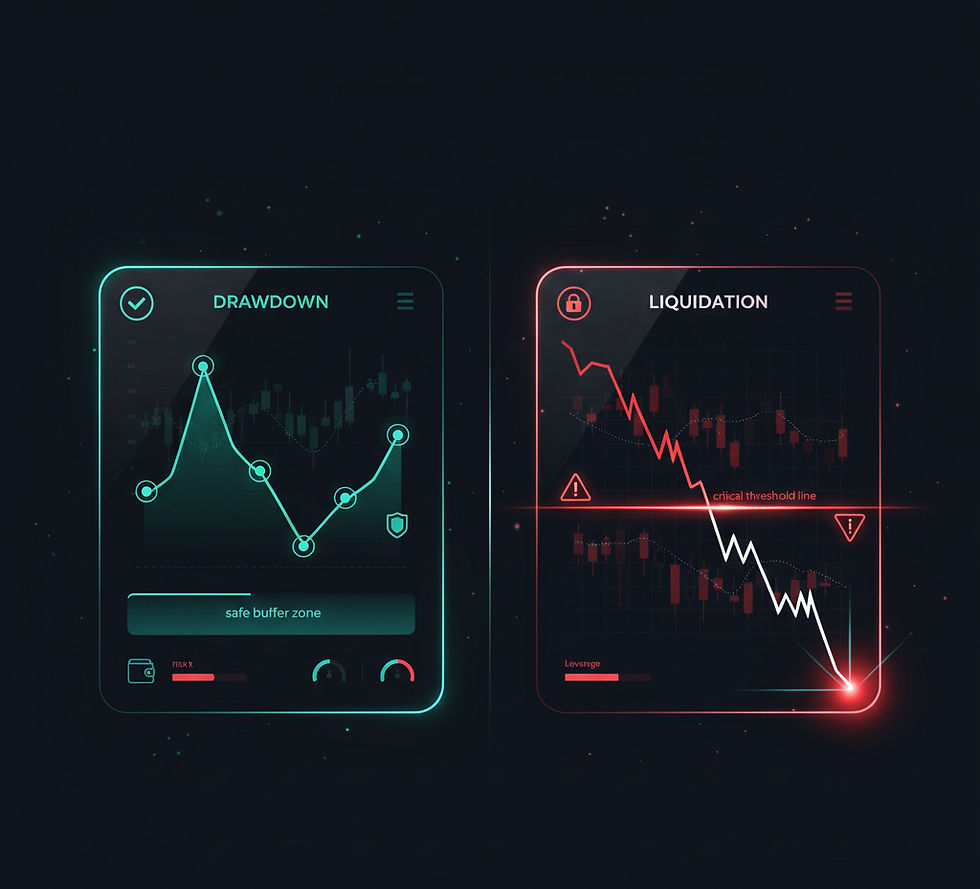
Drawdown vs Liquidation (Side-by-Side Comparison)
Here’s the clearest way to separate them:
Drawdown
Your account value drops, but your trading account is still active
You’re still in control of your risk and decisions
Happens even with smart trading
Can be reduced with better entries, stops, and position sizing
Often recoverable with consistency and patience
Liquidation
Your position is force-closed automatically
Usually caused by high leverage + not enough risk control
You lose control of the outcome once you reach that level
Often happens fast during strong market moves
Can seriously damage (or wipe) an account
How to Avoid Liquidation and Control Drawdowns
You don’t need “perfect trades” to stay safe—you need smart protection habits.
1) Risk Management (Your Safety Rules)
Before entering any trade, know:
How much you’re willing to lose if you’re wrong
Where you’ll exit if the market moves against you
Good traders don’t guess—they plan the loss first.
2) Position Sizing (Don’t Trade Too Big)
Most liquidation stories come from one simple issue: the position was too large for the account.
A simple idea that works:The smaller your trade size, the more room you have to survive normal market movement.
3) Stop Losses (Your Emergency Exit)
A stop loss is an automatic exit you set to limit losses.
It’s like setting a spending limit on a card:
You’re still allowed to spend
But you’re protected from a bad situation going too far
Stop losses help keep drawdowns controlled and help prevent getting pushed toward liquidation.
4) Emotional Discipline (Don’t Panic-Trade)
Liquidation often happens after emotional decisions like:
Revenge trading (trying to “win it back”)
Doubling down on a losing position
Removing the stop loss “just to give it space”
A calm trader follows the plan even when the trade is uncomfortable.
Conclusion
Drawdown is a normal dip in performance that can happen even with a solid strategy.Liquidation is a forced shutdown caused by taking on more risk than the account can handle—often through leverage.
If you focus on:
smart risk management
proper position sizing
using stop losses
staying emotionally steady
…you give yourself the best chance to stay in the game long enough to grow.
This content is provided by Peni2DollarzFx for educational purposes only and does not constitute financial advice.


Comments